The Complete Guide to People Shopping Illustrations for Modern Design Projects
In the digital landscape, visual communication is paramount. Whether you're designing a website, crafting an infographic, or developing marketing materials, the right imagery can convey complex ideas instantly and emotionally. Among the most versatile and universally understood visual elements are illustrations of people engaged in everyday activities. Specifically, a curated pack of people shopping illustrations offers a powerful toolkit for designers and content creators. This article explores the purpose, significance, and practical application of such a resource, breaking down how these simple illustrations can become foundational assets in modern design work.
Understanding Illustration Packs: More Than Just Pictures
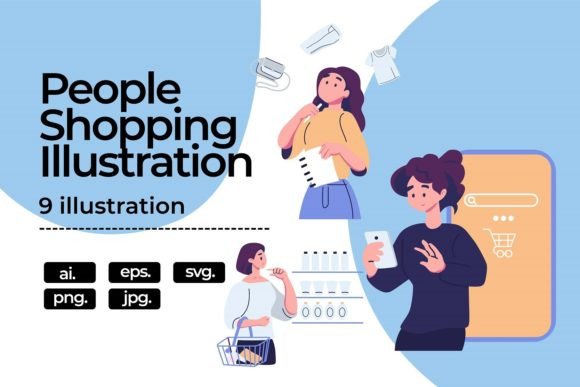
An illustration pack is a cohesive collection of digital artwork centered around a common theme. Unlike random stock photos, these packs are designed with consistency in style, perspective, and aesthetic. The "People Shopping Illustration Pack" described, containing five flat-style illustrations of people shopping, is a prime example. But what does this really mean for a user? First, the flat style refers to a minimalist design approach with two-dimensional shapes, clean lines, and solid colors, devoid of shadows, gradients, or complex textures. This style is not just trendy; it’s highly functional. It ensures clarity, scalability, and a modern look that integrates seamlessly into various design contexts without visual clutter.
The package’s inclusion of multiple file formats—EPS, AI, SVG, PNG, and JPG—is critically important. Each format serves a distinct purpose:
- EPS & AI: These are vector formats editable in professional software like Adobe Illustrator. They allow you to scale the illustrations infinitely without losing quality and modify every element, from colors to shapes.
- SVG: A web-friendly vector format perfect for modern website design, ensuring crisp graphics on any screen size and often enabling animation.
- PNG & JPG: Standard raster (pixel-based) formats for quick placement in documents, presentations, or where transparency (PNG) or universal compatibility (JPG) is needed.
This multi-format approach transforms the pack from a set of static images into a truly editable design asset.
The Significance of the Shopping Theme in Visual Storytelling
Why focus on shopping? Shopping is a fundamental human activity that intersects with commerce, consumer behavior, lifestyle, and technology. Illustrations depicting this act are instantly recognizable symbols for a wide range of concepts. They can represent e-commerce, retail experiences, consumer choice, financial transactions, market research, or simply the idea of acquisition and fulfillment. In an educational infographic about online safety, a person shopping on a laptop can illustrate "secure transactions." In a business presentation, the same illustration might symbolize "customer journey." Their versatility stems from their universal narrative power.
Common misunderstandings here might be that such illustrations are only for "store" websites. Their practical relevance is far broader. They fit into narratives about economics, personal finance, digital apps, user experience design, and social trends. By using a consistent pack, you maintain a professional, unified visual language across all these touchpoints.
Practical Applications Across Modern Domains
Let's explore how this specific illustration pack integrates into contemporary life, work, and creativity.
Website Design & User Interface (UI)
In website design, especially for e-commerce platforms, financial services, or marketplaces, these illustrations are invaluable. A flat-style shopping illustration can be used in hero sections, feature explanations, or empty states within apps. For example, a "Your Cart is Empty" message accompanied by a friendly illustration of a person browsing is more engaging than text alone. The SVG format allows these graphics to load quickly and look perfect on high-resolution displays, directly contributing to a positive user experience and reinforcing brand identity through consistent visual style.
Infographics & Educational Content
Infographics aim to simplify data and processes. A sequence of the five shopping illustrations could visually walk a reader through the steps of a consumer decision-making model: "Research," "Compare," "Select," "Purchase," "Review." The flat style ensures the focus remains on the information, not the ornamentation. For general readers, this makes complex topics like "the circular economy" or "responsible consumption" more approachable and memorable.
Marketing Materials & Business Communications
From social media posts to annual reports, businesses need relatable imagery. These illustrations can adorn blog posts about shopping trends, highlight features in a SaaS product for retailers, or decorate presentation slides about market expansion. Their editable nature, using RGB color format with the ability to change to CMYK, is crucial here. RGB is for digital screens; CMYK is for professional printing. You can seamlessly adapt the pack’s colors to match your exact brand palette for both online campaigns and printed brochures, ensuring total brand coherence.
Supporting Creativity & Daily Design Tasks
For freelance designers, startup founders, or educators creating their own materials, a ready-made, editable pack saves immense time and resources. Instead of commissioning custom art or searching for disparate images that don't match, you have a ready-to-use, professional asset. This empowers small teams to produce work that looks polished and cohesive, elevating their projects without a hefty design budget. It democratizes quality visual content.
Technical Advantages: RGB, CMYK, and Full Editability
A key feature mentioned is that the pack "uses RGB color format and can change to CMYK as you wish with editable color." This is a significant technical benefit. RGB (Red, Green, Blue) is the color model for all digital displays—phones, monitors, TVs. CMYK (Cyan, Magenta, Yellow, Key/Black) is the standard for color printing. Many illustration assets are locked into one model, causing color mismatches when moving from screen to print. With this pack, because the core files (AI, EPS, SVG) are vector-based, you can directly adjust the color values within your design software. You can start with vibrant RGB colors for your website, then easily reconfigure the same illustration to CMYK-optimized colors for a flyer, maintaining visual consistency across all mediums.
The full editability extends beyond color. You can isolate individual elements—a shopping bag, a character, a product—and repurpose them. You can combine illustrations from the pack to create a scene, or adjust line weights to match your project’s style guide. This transforms a pack of five illustrations into hundreds of potential derivative assets, making it a long-term investment rather than a one-use purchase.
Building a Broader Understanding of Design Assets
Viewing this illustration pack not just as "five pictures" but as a system helps you build a broader understanding of modern design resources. It embodies principles of scalability, adaptability, and thematic coherence. In a world where content needs to be responsive (fitting everything from a mobile screen to a billboard) and multi-channel (existing online, in print, in video), having foundational assets that are inherently flexible is non-negotiable. This pack teaches by example: good design resources are those that empower the creator, not constrain them.
Furthermore, using such packs encourages a mindset of visual storytelling. Instead of thinking in terms of decorative images, you begin to think in terms of visual metaphors and narrative sequences. How can the act of shopping illustrate a concept like data selection in a tech tutorial? How can it humanize a dry financial report? This expands your creative and communicative toolbox significantly.
Conclusion: An Essential Tool for Clear Communication
A People Shopping Illustration Pack, especially one with the comprehensive features described, is more than a graphic collection. It is a versatile, professional, and practical tool for anyone involved in visual communication. From explaining topics to general readers in an engaging way, to enhancing business materials with relatable imagery, to ensuring technical compatibility across digital and print media, its applications are vast. By starting with a universally understood theme—shopping—and packaging it in an editable, multi-format, multi-color-model suite, it provides both a solid starting point for beginners and a powerful, adaptable resource for experienced designers. It underscores a central tenet of effective design: the best visuals are those that are clear, consistent, and fundamentally supportive of the message you want to convey.