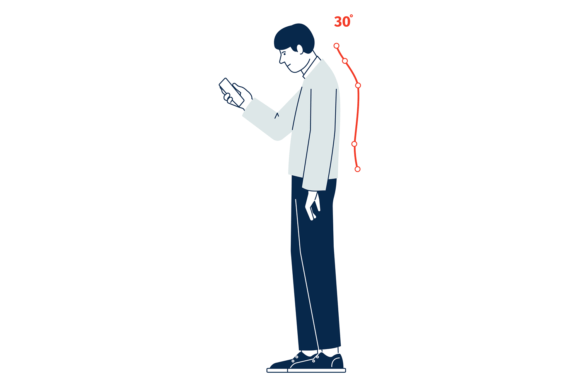
The Impact of a Bad Standing Pose While Looking at Your Phone
It's a scene repeated millions of times a day: a person, standing still, hunched over a smartphone. This specific posture—what we might term the Man Looking at Phone. Wrong Standing Pos—is far more than just a casual stance. It represents a distinct, modern biomechanical position that combines sustained cervical flexion with thoracic rounding and often a forward shift of the pelvis. While it feels natural in the moment, it is a loaded posture with significant implications for musculoskeletal health, differing notably from other common phone-use positions.
What Makes This Posture Distinct?
The Man Looking at Phone. Wrong Standing Pos is defined by several key, simultaneous factors. First, the head is dropped forward, often at a severe angle exceeding 45 degrees, placing immense strain on the cervical spine and the supporting neck muscles. Second, the shoulders round forward, collapsing the chest and tightening the pectoral muscles. Third, the standing base is often unstable—one hip might be cocked, knees locked, or weight unevenly distributed, compromising the natural alignment of the lumbar spine. This is distinct from, say, sitting with a phone, where the pelvis is supported, or walking while looking down, where the posture is transient. The standing version is a static load, a sustained, uncompensated position that the body must resist for minutes or even hours, as people wait, browse, or text.
This posture’s distinctness also lies in its cultural ubiquity and its perceived innocuousness. Unlike a clearly poor lifting technique recognized as dangerous, the Man Looking at Phone. Wrong Standing Pos is socially normalized, making awareness and correction more challenging.
Comparing Common Phone Use Postures and Their Tradeoffs
To understand where the Man Looking at Phone. Wrong Standing Pos fits, it’s useful to compare it with other frequent ways we interact with our devices.
Sitting with Phone on Lap or Table
While sitting can encourage similar cervical flexion, it typically offers more potential for support. Using a table can allow for more forearm support, reducing shoulder strain. However, sitting often exacerbates lumbar flexion ("slouching") and can involve prolonged hip flexion. The tradeoff here is between lower body strain and upper body strain. The standing wrong pose, conversely, avoids the seated hip angle but introduces full-body gravitational load through a misaligned spine.
Walking While Using a Phone
This is a dynamic alternative. The posture may still be poor, but the constant micro-adjustments for balance and movement mean muscles are not locked in a single isometric contraction. The primary risk shifts from musculoskeletal fatigue to environmental hazards (tripping, collisions). The Man Looking at Phone. Wrong Standing Pos is essentially the paused, concentrated version of this, where all the biomechanical stress is amplified by stillness.
Phone Use at Eye Level
This is the often-prescribed "healthy" alternative, where the device is raised to reduce head flexion. This can be achieved standing, but requires conscious effort or support (like holding the phone higher, which can fatigue shoulders). The main tradeoff between the wrong standing pose and this approach is convenience versus intentionality. The wrong pose is the default, effortless path; maintaining eye level requires continuous muscular effort in different muscle groups.
Strengths, Limitations, and Best-Fit Situations
It may seem odd to discuss "strengths" of a harmful posture, but from a purely functional, immediate-gratification perspective, the Man Looking at Phone. Wrong Standing Pos offers the strength of extreme convenience. It requires no setup, no furniture, and minimal conscious thought. It is the fastest way to engage with the device in a standing context. Its limitation, of course, is its profound biomechanical cost.
The best-fit situation for this posture—if one must use it—is in very short durations. A quick 30-second check of a message while standing in line is a low-risk application. Its fit deteriorates rapidly with time. The posture is a particularly poor choice for any activity requiring focused attention for more than two minutes, such as reading an article, browsing social media, or watching a video while stationary. In those scenarios, the cost outweighs the convenience benefit.
When Is This Posture the Right Choice? When Do You Need Another Option?
The Man Looking at Phone. Wrong Standing Pos might be the "right" choice only in a narrow, pragmatic sense: when speed and accessibility are the absolute overriding priorities, and the duration is confirmed to be brief. Think of checking a boarding pass at a airport gate glance, verifying a turn on a map while momentarily halted, or taking a single quick photo.
You need another option in almost all other standing phone-use scenarios. If the task will last longer than a minute, alternatives should be actively sought. The simplest alternative is to raise the device. Holding the phone higher, even if it tires your arms after a while, redistributes the load. Another alternative is to integrate micro-movements: shift weight from foot to foot, gently sway, or occasionally look up and straighten. This breaks the static load. A third, more structural alternative is to find physical support: lean against a wall, pillar, or counter. This external support can help maintain a more neutral spinal alignment by offloading some of the stabilizing work from your core and back muscles.
Realistic Examples and Practical Comparisons
Consider a realistic example: waiting for a coffee order. You have a three-minute wait. Option A: default to the Man Looking at Phone. Wrong Standing Pos, hunching over to scroll through news. For three minutes, your neck, upper back, and lower back are in a sustained, strained position. Option B: hold your phone noticeably higher, around mid-chest level. Your neck is more neutral, but your deltoid and arm muscles will begin to feel the hold. Option C: place your phone on the counter if available, or lean your forearm against your body or the counter to support the weight of the device. This likely offers the best compromise of comfort and alignment.
The practical comparison here is between muscle groups impacted. The wrong standing pose impacts deep, structural postural muscles (neck extensors, erector spinae) that are difficult to relax in that position. The "high hold" option impacts more superficial, larger limb muscles that can be more easily relaxed by lowering the arm intermittently. The supported option attempts to minimize load on both.
Key Decision Factors for Your Posture
Making a more informed decision about your standing phone posture involves weighing a few simple factors.
- Time: Estimate duration. Over two minutes? Avoid the wrong standing pose.
- Task: Is it passive consumption (reading/watching) or active, brief interaction (typing a quick reply)? Longer tasks require better posture.
- Environment: Is there something to lean on? Is there space to sit? Use environmental supports.
- Physical Awareness: Are you already feeling neck or back tension? If so, this is a strong signal to choose any alternative posture.
- Device Size: Larger phones and tablets exacerbate the problem due to weight and viewing angle; they make alternatives like holding at eye level more challenging, perhaps pushing you towards seeking support.
Ultimately, the Man Looking at Phone. Wrong Standing Pos is a default behavior born from convenience. Its comparison with other postures shows it to be uniquely taxing due to its static, unsupported, and misaligned nature. By understanding its distinct mechanics, the tradeoffs involved, and the realistic alternatives for different situations, you can make deliberate choices that balance device access with physical well-being. The goal isn't perfection, but informed variation—breaking the sustained load of that one wrong pose with moments of better alignment, movement, and support.